





What Is an Electric Fence Energizer? Joules, Voltage and Sizing
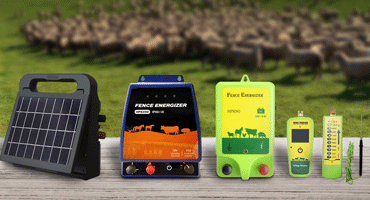
An electric fence energizer is the power unit that converts mains, battery or solar electricity into short high-voltage pulses and sends them onto the fence line. It is the heart of the system: the wire, insulators and ground rod can all be perfect, but without a working energizer the fence is a length of inert metal.
An energizer stores energy in a capacitor and discharges it about once per second as a brief high-voltage pulse. IEC 60335-2-76 limits that pulse to 5 J, 10 ms and 1 Hz. Two ratings decide performance: delivered joules, which sets how much fence length and vegetation the unit can drive, and peak voltage, which pushes the pulse through wool, mud and grass. Choose joules for the job and use voltage as the health check.
Quick facts
- An electric fence energizer stores energy in a capacitor and discharges it about once per second.
- Delivered output runs at roughly 60% of the rated input joules across the HPS FENCE solar range.
- IEC 60335-2-76 limits output to 5 J, 10 ms and 1 Hz measured into a 500 Ω load.
- Sizing order: species first, then fence length and vegetation, then power source.
What happens inside an electric fence energizer
An energizer is not a transformer that continuously electrifies a wire. Three stages run in sequence, roughly once per second.
- Charge: the power supply fills an internal capacitor to a set energy level, measured in joules.
- Discharge: a switching circuit dumps that charge into a step-up transformer, which raises the voltage to several thousand volts.
- Recover: the capacitor recharges while the pulse decays, producing the rest interval that keeps contact safe.
Because the energy is stored and released rather than drawn continuously, a farm energizer can deliver a peak of 8,000–10,000 V while drawing only a few watts from the supply. The average current is tiny; the peak is what the animal feels.
Electric fence energizer specifications that matter
| Specification | What it tells you | What it does not tell you |
|---|---|---|
| Output energy (J) | How much fence length and vegetation the unit can drive | Whether the figure is stored or delivered — always check |
| Peak voltage (V) | Whether the pulse can push through wool, hide and wet grass | How much energy sits behind that voltage |
| Rated range (km / miles) | A clean-line maximum under ideal conditions | Real performance with several wires or heavy growth |
| Power source | Where the fence can be installed | How output behaves in winter or after a week without sun |
Electric fence energizer joules: stored vs delivered
This is the single most common source of disappointment. Stored energy is what the capacitor holds; delivered energy is what reaches the fence terminal after losses in the transformer and switching circuit. A unit advertised by stored joules will always look stronger than one advertised by output joules, even when the second one holds a longer fence.
Our own solar range publishes both figures, and the relationship is consistent: delivered output lands at roughly 60% of the input rating across the line.
A 40% loss is normal engineering. The practical rule: when comparing two brands, convert both to delivered joules first, then compare. A 6 J input unit that delivers 3.6 J is weaker than a 5 J output unit that delivers all 5 J.
Electric fence energizer power sources: AC, DC and solar
Mains (AC)
Highest output per unit cost, no battery maintenance. Needs a dry, sheltered mounting point and a properly earthed supply. Default on farmsteads.
Battery (DC)
Runs from a 12 V battery and suits paddocks without power. Output falls gradually as the battery discharges, so test voltage rather than trusting the lamp.
Solar
Panel charges a battery that runs the unit. Convenient for remote sites, but output depends on panel angle, shade and battery condition. Expect less in winter.
Where to install an electric fence energizer
- Shelter: mount under cover, out of direct rain and spray, even for weather-resistant models.
- Ventilation: leave space around the casing; energizers warm up during operation.
- Height: above flood level and out of reach of children and livestock.
- Lead length: keep the cable run to the fence short and use adequate conductor size to avoid losing energy before the pulse leaves the yard.
- Ground separation: run the earth lead away from the fence lead rather than bundling them together.

How to size an electric fence energizer in three steps
Step 1 — species. Poultry and pets run on 0.25 J. Sheep and goats need 0.5 J and closer wire spacing because wool insulates. Cattle and horses start at 1 J, with 2–3.5 J for long multi-wire runs. Heavy wildlife pressure starts at 4.8 J.
Step 2 — distance and vegetation. Take the rated range and halve it if there is grass under the bottom wire, brush along the line, or more than two strands. Distance ratings assume a clean conductor.
Step 3 — power. If mains reaches the site, take it: more output for the money and no battery to service. If it does not, choose solar over battery on sites you cannot visit weekly, and battery where you can.
Do not size by animal alone
A 0.25 J unit can stop a pony in a small paddock and fail completely on a two-kilometre boundary. Length, wire count and vegetation matter as much as the species.
Electric fence energizer models across the range
These six cover the common duty points, from poultry netting to large remote pasture. Every unit carries a two-year warranty.

Entry · AC
0.13 J output · 110–240 V
Poultry netting, pets and small plots.
View product details
Mixed stock · AC
1 J output · 110–240 V
The step up for sheep, goats and calves on longer runs.
View product details
Dual source
0.5 J · AC + 12 V
Keeps pulsing when mains drops out.
View product details
Horses · AC/DC
3.5 J · 250 acres · 55 miles
Long multi-wire runs for horses and cattle.
View product details
Solar · 1 J
1 J stored · 8,000 V peak
Off-grid livestock and predator control.
View product details
Solar · large
8 J input · 4.8 J output · 80 miles
Big pasture and high vegetation load, off-grid.
View product detailsReading electric fence energizer indicator lights
Most energizers use a single lamp or small display to show pulse activity. A steady flash at roughly one-second intervals means normal operation. A fast or erratic flash usually indicates a heavy load on the fence — vegetation contact or a short circuit. No flash at all points to a supply or internal fault.
Indicator lights are a guide, not a measurement. Only a fence voltage tester tells you what an animal would receive at the far end of the run.
Electric fence energizer maintenance that extends service life
- Check terminals every season for corrosion and tighten loose connections.
- Clear vegetation before it touches the conductor.
- Test the earth array, not only the fence wire, after long dry spells.
- Keep the casing free of dust and insect nests, which cause overheating.
- Disconnect during electrical storms if the site is prone to surges.
Electric fence energizer FAQ
How many joules do I need for cattle?
Start at 2 J delivered for a multi-wire cattle fence of moderate length, and move up if the run is long or vegetation pressure is high. A 1 J unit can work on short clean runs with trained animals, but leaves little margin.
Can a bigger energizer damage my fence?
No. The fence and insulators are designed for high voltage. A larger energizer simply maintains voltage over a longer run or through heavier vegetation. Damage usually comes from physical faults, not output.
How long does an energizer last?
Quality units commonly run for ten years or more. Capacitors and switching components age, and lightning damage is the main cause of early failure. Surge protection and a sheltered mounting point extend life considerably.
Why does my energizer click loudly?
The click is the pulse discharge and is normal. A change in rhythm, an unusually loud click, or clicking with no voltage suggests a fault or a heavy load on the fence.
Can I run two fences from one energizer?
Only as one continuous circuit. Two physically separate fences need a connecting lead or a second energizer, because a single unit cannot pulse two isolated circuits at once.

HPS FENCE · MANUFACTURER & WHOLESALE SUPPLIER
Your Trusted Partner for Electric Fencing & Farm Solutions
From electric fence energizers and fencing accessories to poultry farming equipment, HPS FENCE supports global distributors, wholesalers, importers, and brands with reliable products, flexible OEM/ODM customization, and long-term supply solutions.
Sources
- IEC 60335-2-76:2002+A1:2006 and BS EN IEC 60335-2-76:2021 — electric fence energizers: output energy ≤5 J, pulse duration ≤10 ms, repetition rate ≤1 Hz.
- HPS FENCE product specifications — input and output energy values across the HPSA, HPS, HPSS and JX series.
- IEC 60479-1 — effects of current on human beings and livestock, referenced for pulse-safety context.