








Is an Electric Fence Safe for Animals? What the Data Says
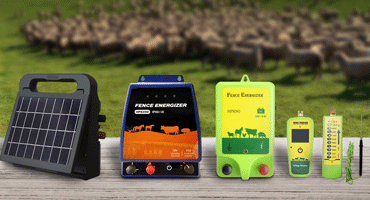
An electric fence is safe for animals when the energizer, the conductor and the earth are correctly specified and maintained. The shock is deliberately unpleasant but physiologically small: international standards cap it at 5 joules per pulse, delivered in under 10 milliseconds, no more than once per second. The risks that matter in practice are entanglement, faulty equipment and poor visibility, not the pulse itself.
Yes. A compliant electric fence energizer is limited by IEC 60335-2-76 to a maximum of 5 J per pulse, a pulse duration of 10 ms or less, and a repetition rate of 1 Hz or less, measured across a 500 Ω load that represents a human or animal body. Field studies show cattle receive most of their shocks on the first day of exposure and often none afterwards, and controlled trials on horses found no rise in heart rate, heart rate variability or salivary cortisol on electrically fenced paddocks.
Quick facts
- IEC 60335-2-76 limits energizer output to 5 J per pulse, 10 ms duration and 1 Hz repetition.
- IEC 60479-1 places the AC let-go threshold at about 10 mA for men and 6 mA for women.
- 90% of all shocks in a naive cattle group occurred on the first day of exposure.
- Horse paddocks fenced electrically showed no rise in heart rate, HRV or salivary cortisol (Glauser 2015).

Electric fence safety standards: what IEC 60335-2-76 limits
Electric fence safety is not a marketing claim. It is a set of measurable limits defined in IEC 60335-2-76, the international safety standard for electric fence energizers, adopted in Europe as BS EN IEC 60335-2-76 and harmonised in North America through UL 69. The standard tests output across a 500 Ω resistive load, a value chosen to approximate the impedance of a body in contact with the fence.
| Parameter | Limit under IEC 60335-2-76 | Why it matters |
|---|---|---|
| Energy per pulse | ≤ 5 J into a 500 Ω load | Caps the total energy a single contact can deliver |
| Pulse duration | ≤ 10 ms | Keeps the exposure far shorter than a muscle contraction cycle |
| Repetition rate | ≤ 1 Hz (one pulse per second) | Guarantees a rest interval so an animal can release the wire |
| Peak current (2020 amendment) | ≤ 20 A for no more than 200 µs cumulative | Limits the instantaneous current spike |
| Fault behaviour | Output must fall to a safe level within 300 ms | Prevents a continuous shock if a component fails |
The rest interval is the most important number in that table. IEC 60479-1, the reference standard for the effects of current on humans and livestock, describes the let-go threshold: the current at which a person or animal can still release a conductor. At mains frequency that threshold is roughly 10 mA for adult men and 6 mA for adult women, while a single short DC pulse can be perceived from about 2 mA. A pulsed energizer stays below injurious levels partly because the pulse ends before the body can lock onto it.
How an electric fence shock compares with harmful current levels
The chart below places a standard-compliant fence pulse next to published physiological thresholds. The comparison is the whole argument: the fence operates in the perception range, not the injury range.
How quickly animals learn an electric fence
Safety also depends on exposure time. An animal that keeps testing the fence receives repeated shocks; an animal that learns the boundary receives none. The published behaviour data shows learning happens fast.
That pattern repeats across species. Feral pigs in a 100-hour observation received 61% of all shocks within the first 30 minutes. Feral goats were considered trained after seven days. The practical implication is that a well-built fence produces a short learning period and then very little aversive contact for the rest of the season.
Electric fence safety by species: cattle, horses, sheep and poultry
Safety is species-specific because body mass, coat and behaviour change how the animal meets the fence.
| Species | Welfare evidence | Design point that matters |
|---|---|---|
| Cattle | Most animals receive zero or one shock in the first week | Two to three wires at chest height; train in a small paddock first |
| Horses | No difference in heart rate, HRV or salivary cortisol versus wooden fencing | Visible polytape; never thin wire alone; allow extra paddock area |
| Sheep | Multi-wire or netting recommended; wool reduces the shock received | Closer wire spacing and a higher joule rating |
| Goats | Four-wire designs successfully contained feral goats in trials | Low wire at nose height plus a second strand |
| Pigs | Single strand contains pigs above roughly 5 kg; smaller pigs need netting | Low mounting height; a naive pig may lunge forward rather than back |
| Poultry | Netting is the standard approach against foxes and dogs | Small mesh, low profile, regular vegetation control |

The electric fence risks that actually cause injury
The shock is rarely the cause of injury. The documented welfare problems come from how the fence is built and maintained.
- Entanglement: an animal that pushes through netting or thin wire can become caught and panic. The British Veterinary Association cites entanglement as the main welfare concern across all fence types and recommends high-visibility tape or rope for horses.
- Continuous output: a failed component that produces a continuous rather than pulsed current removes the rest interval. This is a fault condition, not a design feature, and the unit should be disconnected immediately.
- Inadequate earth: a poor earth reduces the shock to a tickle, which encourages animals to keep challenging the fence and increases total exposure.
- Wrong energizer for the species: an oversized unit on a small, confined paddock delivers more discomfort than needed. The BVA asks for current strength appropriate to the species.
- Poor visibility: animals that cannot see the conductor run into it. Marking tape, flags and clear sightlines reduce both injury and stress.
- Battery condition: damaged or leaking batteries are a toxicity and environmental hazard. House them in a robust, visible enclosure.
What the professional bodies say
The British Veterinary Association supports the responsible use of electric containment fences for livestock and horses, provided the current is matched to the species, the fence is visible, animals are trained in a controlled setting, and installation follows AHDB or National Equine Welfare Council guidance. It also calls for more research into non-aversive alternatives. That is a qualified endorsement, not a free pass.
Electric fence safety: what field studies show
Safety has a second dimension: whether the fence does its job without the livestock paying a cost in losses. The published effectiveness data is consistent across countries.
The variance in those numbers is informative rather than contradictory. The Nepal study recorded 30–60% depending on site, and the authors attributed the difference to fence placement relative to wildlife corridors and the standard of maintenance. A fence that is not maintained does not stay effective, which is why inspection belongs in any safety discussion.

Six rules for a safe electric fence installation
- Use an energizer certified to IEC 60335-2-76, UL 69 or the equivalent national standard. The output limits are the safety case.
- Match the joule rating to the species and the paddock size. More energy is not safer, it is simply more aversive.
- Drive a proper earth array — at least three rods in damp soil — so the fence trains animals instead of annoying them.
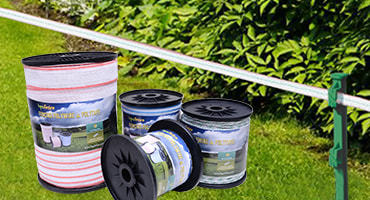
- Keep the conductor visible: wide tape for horses, flags or markers on wire in open paddocks.
- Train new animals in a small, conventional-fenced pen with one live wire before turning them out.
- Walk the fence weekly and after storms, checking voltage, insulators, vegetation contact and battery condition.
Electric fence safety FAQ
Can an electric fence kill a dog or a cat?
A compliant livestock energizer is designed to startle, not to injure a healthy adult animal. The pulse is capped at 5 J and 10 ms, well inside the perception range. Small animals and animals with heart conditions are more vulnerable, so keep output modest and never use a security-grade energizer around pets.
Is an electric fence safe for pregnant animals?
Standard-compliant pulses are widely used on breeding stock. The practical concerns are stress from repeated chasing and the risk of entanglement, not the pulse. Keep the fence visible, maintain voltage and avoid confining heavily pregnant animals in small electrified pens.
What voltage is too high for animals?
Voltage alone is not the safety measure. The standard limits energy and duration, not open-circuit voltage, and most farm energizers run at 6,000–10,000 V. A fence reading high with low energy is normal. A fence delivering a continuous shock is a fault and must be switched off.
Does the shock hurt?
Yes, briefly. That is the mechanism. The discomfort lasts for the duration of the pulse, under 10 ms, and the animal can release the conductor between pulses. Published behaviour data shows most animals stop contacting the fence after one or two experiences.
Are electric fences worse than barbed wire for welfare?
Veterinary bodies describe electric fencing as an alternative to barbed wire, which carries a high risk of cuts and entanglement. Both require correct design and maintenance. The main welfare risk with electric fencing is entanglement in netting or thin wire, which visible tape and correct tension largely solve.
HPS FENCE · MANUFACTURER & WHOLESALE SUPPLIER
Your Trusted Partner for Electric Fencing & Farm Solutions
From electric fence energizers and fencing accessories to poultry farming equipment, HPS FENCE supports global distributors, wholesalers, importers, and brands with reliable products, flexible OEM/ODM customization, and long-term supply solutions.
Sources
- IEC 60335-2-76:2002+A1:2006 and BS EN IEC 60335-2-76:2021 — household and similar appliances, particular requirements for electric fence energizers: output energy ≤5 J, pulse duration ≤10 ms, repetition rate ≤1 Hz.
- IEC 60479-1 — effects of current on human beings and livestock: let-go thresholds and body impedance values.
- Alberta Agriculture, Food and Rural Development — Protecting Livestock From Predation With Electric Fences: 90% reduction in sheep predation losses.
- Sapkota S. et al. — Economic Analysis of Electric Fencing for Mitigating Human-wildlife Conflict in Nepal, Journal of Resources and Ecology 5(3): 237–243, 2014.
- University of Colombo — Effectiveness of Electric Fences in Human-Elephant Conflict Areas, Sri Lanka: 90% reduction in livestock depredation.
- Norwegian Scientific Committee for Food and Environment (VKM) Report 2017:31 — review of electric devices used to modify animal behaviour, summarising McDonald 1981, Bartay 1979 and Glauser 2015.
- Glauser A. et al. — No increased stress response in horses on small and electrically fenced paddocks, Applied Animal Behaviour Science, 2015.
- British Veterinary Association — policy position on the use of electric containment fences in livestock and horses.