




How Many Joules for an Electric Fence? Sizing by Species and Distance
“How many joules for an electric fence?” is the question that decides whether a fence works, and the honest answer depends on three things: the animal, the length of the fence and how much vegetation touches it. This guide gives the joule figure for each species, explains why the label number is not the number that reaches the fence, and shows which of the 1, 2, 3, 4, 6, 10 and 12 joule classes actually fits a given farm.
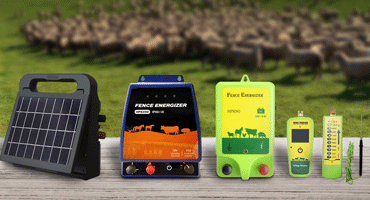
For most farms the answer is 2–4 J of delivered energy: about 2 J for 20–50 head of cattle on a short run, 3.5 J for 50–150 head or a long boundary, and 4.8 J where grass loads the line. Poultry netting needs only 0.25–1 J, horses 1–3.5 J, and wooled sheep need the highest voltage, not the highest joule count. Size on fence length first, then add one band for wool, wet vegetation or a poor earth.
Quick facts
- Cattle and goats need 2,000 V at the far end; wooled sheep 3,000 V; horses and pigs 1,500 V (KZN Agriculture & Rural Development).
- A 6 J energizer typically delivers about 3.6 J at the terminals — roughly 60% of the stored rating.
- IEC 60335-2-76 caps every fence pulse at 5 J, 10 ms and 1 Hz, so a “12 J” energizer still complies only if its output pulse stays inside those limits.
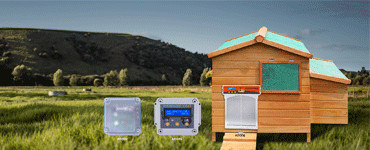
- MOQ is one unit on energizers, testers and coop doors, with mixed-model orders accepted.
How many joules for an electric fence: the answer by animal
Joules are the work the pulse can do; voltage is the pressure that pushes it through hide, wool or grass. Both matter, but the joule figure is what decides whether the first contact is unmistakable.
| Animal | Voltage target at the far end | Delivered joules | Why |
|---|---|---|---|
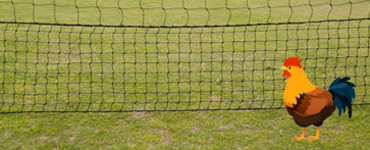
| Poultry netting | 2,000 V | 0.25–1 J | Short runs; the netting limits current, not the energizer |
| Horses | 1,500 V | 1–3.5 J | Thin skin, sensitive; visibility matters as much as energy |
| Pigs | 1,500 V | 1–2 J | Thin skin but strong urge to root under the wire |
| Cattle | 2,000 V | 2–4 J | Thin hide, learns after one or two contacts |
| Goats | 2,000 V | 2–4 J | Test fences with horns and shoulders |
| Sheep, wooled | 3,000 V | 3.5–4.8 J | Wool insulates the animal from the conductor |
| Deer and wildlife | 3,000 V+ | 4.8–8 J | Jump or push through unless the barrier is high and hot |
Voltage targets follow KZN Agriculture & Rural Development guidance and are read at the far end of the fence, not at the terminals.
Electric fence joules for cattle, horses, goats and deer
The cattle number is the one most buyers ask about, and it is lower than the market implies. A 100-head suckler herd on a permanent boundary fence is a 3.5 J job, not a 12 J one; the extra stored energy buys nothing on a clean run and costs more in battery drain.
Goats sit at the same voltage as cattle but punish layout mistakes: they push under the bottom strand and browse over the top. Deer are the opposite problem — they jump, so the joule figure has to be paired with height and a wide, visible top wire.
Stored versus delivered joules: why a 6 J label can deliver 3.6 J
Every energizer stores energy in capacitors and releases it in a pulse; the transformer and switching circuit lose part of that energy on the way out. The label describes what is stored. The fence receives what survives the circuit, and the difference is around 40% on most designs.
Measured into a resistive load at the terminals. The 13% case is a real independent test of a unit sold as 12 J.
This is why “how many joules” needs a second question: delivered or stored? A supplier who answers with a single number and no load condition is quoting a label. The test method is published here.
Joule ratings explained: 1, 2, 3, 4, 6, 10 and 12 joule chargers
| Joule class | Delivered (approx.) | Fence length it holds | Typical buyer |
|---|---|---|---|
| 1 joule | 0.5–0.6 J | Up to about 10 km clean | Poultry, smallholding, temporary runs |
| 2 joule | 1.2–1.4 J | Around 20 km | Mixed grazing up to 50 head |
| 3 joule | 1.8–2.0 J | 25–30 km | Horses and cattle on mid-size farms |
| 4 joule | 2.4–2.8 J | 35–45 km | Cattle with vegetation contact |
| 6 joule | 3.6 J | Up to about 60 km / 60 miles | Long boundaries, mixed herds |
| 10 joule | 6 J | 80–100 km | Large stations, wildlife |
| 12 joule | 7.2 J | 100 km+ | Reserves, elephants, extreme length |
Ranges are conservative working figures for clean wire and a correct earth; halve them for heavy grass or a poor earth.
AC vs DC electric fence chargers: does the joule answer change?
No — the joule requirement is set by the fence, not by the power source. What changes is reliability. A mains AC unit delivers its rated output indefinitely; a 12 V battery unit delivers the same output until the battery fades, and then delivers less without warning. That is why battery and solar units are usually specified one band higher for the same fence.
- AC mains: lowest cost per joule, no maintenance, needs a power point at the fence.
- 12 V battery: portable and independent, but battery condition becomes part of the specification.
- AC/DC combination: one SKU that covers both customer types — the usual dealer choice.
- Solar: independent and self-charging, sized one band up for winter.
Battery powered and 12 volt electric fence chargers
A 12 V charger is the right answer for leased blocks, strip grazing and anywhere the fence moves. Two details decide whether it holds its joule rating through the season: the battery capacity and the low-voltage cut-off. A unit that keeps pulsing on a flat battery delivers a weak pulse the animal learns to ignore, which is worse than no fence at all.
Solar joule ratings: 1 joule, 3 joule and 4 joule solar chargers
Solar ratings follow the same stored-versus-delivered logic. A 1 joule solar charger suits poultry netting and small paddocks; 3.5 J solar is the practical unit for 30 miles of cattle fence; 4.8–6 J solar covers 60 miles or a cold-climate site where winter capacity forces one band up. Panel angle and battery chemistry decide whether the rated joules are still there in January.
Two strand electric fence for cattle: why layout changes the number
A two-strand fence is cheaper and faster to erect, but it concentrates the animal's attention on one or two contact points. It works with cattle when the strands sit at roughly 450 mm and 900 mm, the wire is high-tensile, and the energizer has margin — a 2 J unit on a two-strand fence behaves like a 1 J unit on five strands, because there is no redundancy if a strand shorts to grass.
- Two strands: 3.5 J delivered gives margin for a single fault.
- Three to five strands: 2 J is often enough on clean, dry ground.
- Any layout through long grass: add one joule band.
- Gate sections and buried cable: the two places a two-strand fence fails first.
Best electric fence charger for cattle, dogs and deer
| Use case | Recommended energizer | Joules |
|---|---|---|
| Cattle, 20–50 head | HPSA200-AC/DC, 9 kV peak | 2 J |
| Cattle, 50–150 head | HPS350 AC/DC | 3.5 J |
| Cattle, long run through grass | HPS480 AC | 4.8 J |
| Dogs and garden containment | HPSA050-AC/DC | 0.5 J |
| Poultry netting | HPSA025 AC | 0.25 J (0.13 J delivered) |
| Deer and wildlife | HPS800 | 8 J (4.8 J delivered), 13 kV |
For a dealer's range, these six cover most enquiries without holding twenty models.
HPS FENCE as an electric fence energizer manufacturer
HPS FENCE is the brand of Hangzhou Opus Fence Supplies Co., Ltd, building energizers in Hangzhou since 2013 with category experience back to 2002. Output spans 0.25 J to 12 J across mains, battery, solar and AC/DC formats, sealed to IPX6, and shipped to distributors in Australia, New Zealand, Europe, the United States, Canada, South America, Korea and Japan.
Real output test method published, not just a label value.
Read the test methodContinuous run with output, energy and temperature monitored.
See the production processPackaging verified for container and parcel transit before release.
See the drop testVerification tied to production batches, not a single prototype.
View certificationsEvery unit checked before packing, with batch traceability.
Inspection stepsOEM and private label for joule ratings
Private label covers the housing label, retail box, manual, model naming, colour and output specification. A label-only change starts at one unit on stock models; a new joule rating or housing is quoted as an ODM project with MOQ confirmed per project.
Branding and packaging
- Logo on housing, retail box and manual
- Model naming and colour to suit your catalogue
- Packaging engineered for e-commerce and container transit
Technical and documentation
- Output voltage and joule specification per market
- Multilingual manuals
- Full ODM development with scheduling and sample approval
Wholesale electric fence energizer terms
Six energizers across the joule range

0.25 J mains
0.25 J stored · 0.13 J delivered · 110–240 V AC
Poultry netting and garden runs where a larger unit adds nothing.
View product details
0.5 J dual source
0.5 J delivered · AC 110–240 V or 12 V DC
Smallholdings, dogs and starter dealer ranges.
View product details
2 J dual source
2 J delivered · 9 kV peak · AC or 12 V
20–50 head of cattle on permanent boundary fence.
View product details
3.5 J workhorse
3.5 J · 55 miles clean fence · 250 acres
The default for 50–150 head and multi-paddock grazing.
View product details
6 J solar
6 J input · 3.6 J delivered · 60-mile range
Remote cattle runs with no mains supply.
View product details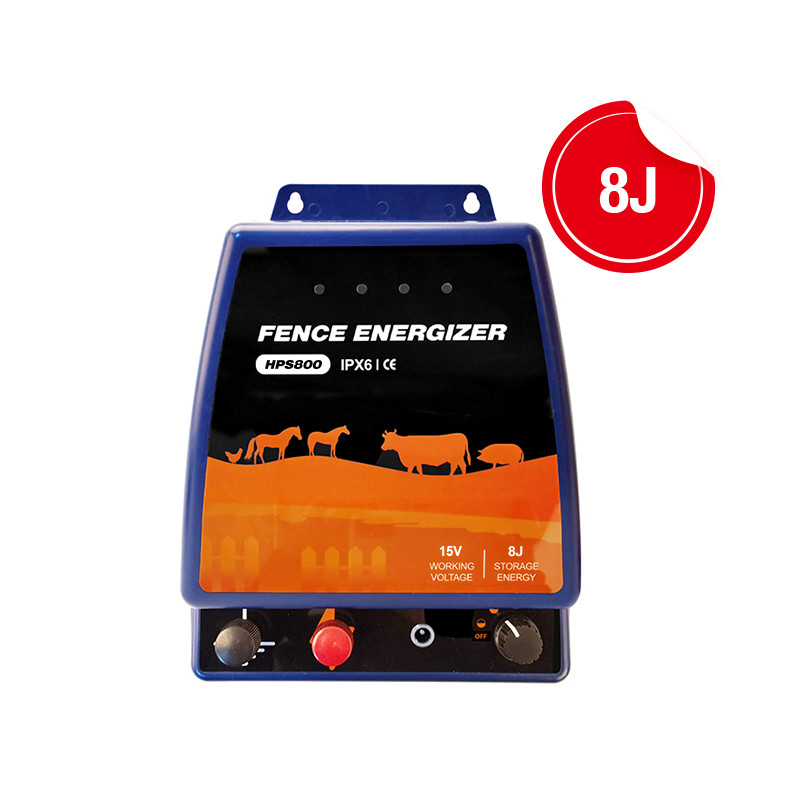
8 J high power
8 J input · 4.8 J delivered · 13 kV · 80 km
Deer, wildlife and reserve boundaries.
View product detailsHow many joules for an electric fence: FAQ
How many joules for an electric fence for cattle?
2–4 J delivered covers most cattle farms: 2 J for 20–50 head on a short permanent run, 3.5 J for 50–150 head, 4.8 J where grass touches the wire. Voltage at the far end should stay above 2,000 V.
How many joules for electric fence for horses?
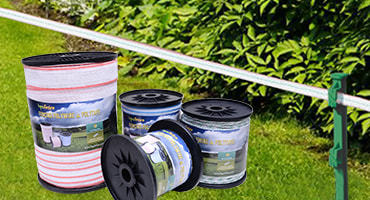
1–3.5 J. Horses need only about 1,500 V, so the joule figure matters less than visibility: a 2–3.5 J unit driving 40 mm tape outperforms a 6 J unit on thin wire.
How many joules for dogs, goats or deer?
Dogs: 0.5 J on a short garden run. Goats: 2–4 J with a low bottom strand. Deer: 4.8–8 J with height and a wide visible top wire, because deer jump rather than push.
Is a 12 joule charger better than a 4 joule one?
Only on very long runs, heavy vegetation or thick-skinned wildlife. Above 4.8 J the returns flatten for livestock, while cost, battery drain and earth requirements rise.
What is the MOQ for wholesale electric fence energizers?
One unit on energizers, testers and coop doors; 100 units on other categories. Mixed-model orders are accepted, so a distributor can stock four joule bands in one shipment.
Sources
- KZN Department of Agriculture & Rural Development — Electric Fencing in Agriculture: voltage minima by species, earth requirements, conductor spacing.
- IEC 60335-2-76:2002+A1:2006 / BS EN IEC 60335-2-76:2021 — output energy ≤5 J, pulse duration ≤10 ms, repetition rate ≤1 Hz.
- IEC 60479-1 — effects of current on human beings and livestock.
- HPS FENCE product specifications — delivered output energy, peak voltage and power source across the 0.25–12 J range.
- HPS FENCE — How to Test Real Output: measured efficiency of 12 J models at about 58–60%, and independent data showing low-quality units at 11–13%.
Related electric fence sizing guides
- Choosing the Right Size Fence Energizer — the four measurements that settle the size band.
- Best Electric Fence Energizer: 7 Models Ranked — which model to pick once the joules are decided.
HPS FENCE · MANUFACTURER & WHOLESALE SUPPLIER
Your Trusted Partner for Electric Fencing & Farm Solutions
From electric fence energizers and fencing accessories to poultry farming equipment, HPS FENCE supports global distributors, wholesalers, importers, and brands with reliable products, flexible OEM/ODM customization, and long-term supply solutions.