








How Electric Fence Energizers Are Tested: 72-Hour Ageing, Joule Output and Drop Tests
Most electric fence energizer failures are not random. They are predictable, and they are visible on a test bench months before a customer sees them. This is the process we run on every unit — joule output measurement, 72-hour ageing, box drop, water ingress and final electrical inspection — and the questions a buyer should ask to confirm a supplier actually runs it.
An electric fence energizer should be tested on five points before shipment: delivered joule output measured on an oscilloscope, a 72-hour continuous ageing run with output and temperature logged, a box drop test for transport packaging, IPX6 water ingress verification, and a final electrical inspection covering pulse waveform, conversion efficiency and insulation strength. A manufacturer that cannot show records for all five is selling you a sample, not a production process.
Quick facts
- Every HPS FENCE energizer runs a 72-hour continuous ageing test before packing.
- Measured conversion efficiency on our 12 J model is 58%; a 12 J unit delivering 7.2 J represents a 60% reference point.
- In our own bench tests, competitor efficiency has ranged from around 11% to over 50%.
- HPS FENCE holds CE, RoHS, TÜV and SGS certification plus ISO 9001, with IPX6 protection across the energizer range.
Why electric fence energizer testing decides your return rate
Three failure modes account for most field returns in this category: a unit that never reaches its rated output, a unit that fails within the first weeks of use, and a unit that arrives physically damaged. Each has a specific test that catches it before shipment — and each is cheap to run compared with the cost of a return from another continent.
For a distributor, the cost of a return is not the unit. It is the freight, the credit note, the customer conversation and the review that follows. Testing is the only mechanism that converts those costs into a bench reading.
Test 1 — Joule output: stored energy versus delivered energy
This is the test most suppliers avoid, because it exposes the gap between the number on the box and the energy that reaches the fence. Stored energy is what the capacitor holds before discharge. Delivered energy is what leaves the terminal after conversion losses in the transformer and switching circuit.
We measure it with an oscilloscope, capturing the waveform voltage and current duration, then integrating energy over the pulse. The result is a delivered figure that can be compared directly with a competitor's delivered figure — which is the only fair comparison.
The three questions that expose a stored-energy claim
Ask: is this figure stored or delivered? What load resistance was it measured into? Can you send the waveform? A compliant measurement is taken into a 500 Ω load under IEC 60335-2-76, and the waveform shows the pulse duration directly.
Test 2 — 72-hour ageing: screening early failures
Most electronic failures happen in the first hours of operation, not the tenth year. Ageing — sometimes called burn-in — is designed to force those failures to occur in the factory rather than in a paddock.
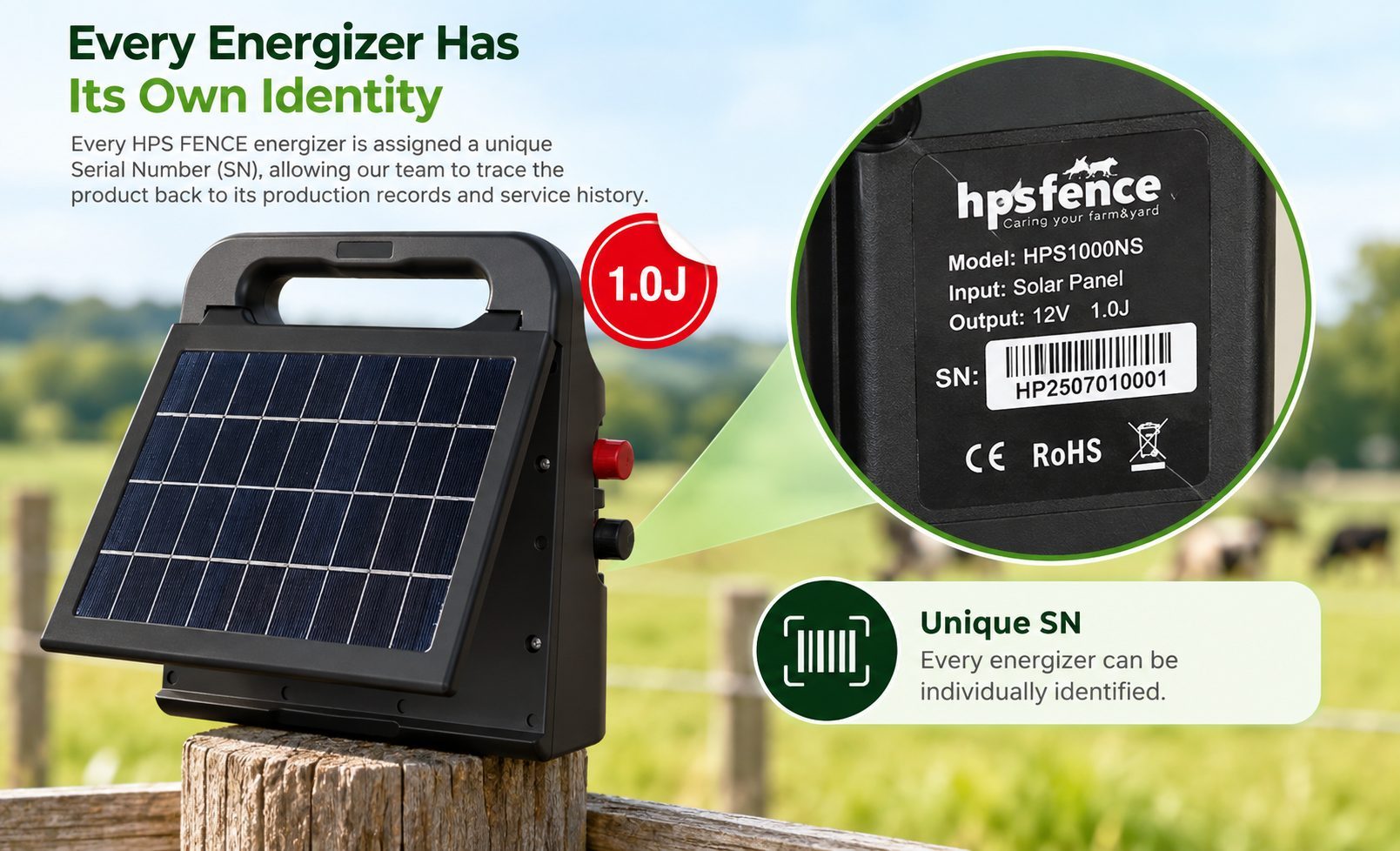
Every HPS FENCE energizer runs a 72-hour continuous ageing test before packing. During the run, output voltage, joule energy and temperature variation are monitored; any deviation outside the standard parameters is logged and reviewed by the quality team before the unit is released.
The purpose is not to prove the unit works. It is to prove it keeps working when the ambient temperature climbs, the load changes and the pulse count reaches the tens of thousands. A unit that survives 72 hours of continuous pulsing has already done more work than many fences will do in a month.
Test 3 — Box drop test: packaging is part of the product
A energizer that arrives with a cracked housing is a failed product, even if the circuit board is perfect. For e-commerce sellers and importers, packaging reliability shows up directly in return rates and reviews.
Our drop test simulates the real logistics chain rather than a single impact: the box is dropped from different heights and orientations, with attention to the corners and edges that fail first in electronic packaging. Passing means more than an intact carton — the unit must power up and hold output after the drop.
- Multiple heights and orientations, not one controlled drop.
- Function check after impact, not only visual inspection.
- Design feedback loop — foam density, inner bracing and carton grade are revised based on the results.
- Approval gate — packaging that fails is not released to mass production.

Test 4 — IPX6 water ingress: verified per batch
Outdoor energizers live in rain, spray and condensation. IPX6 covers powerful water jets, which is the relevant rating for a unit mounted on a fence post rather than under a roof.
The distinction that matters commercially is whether the rating is verified per batch or only on a prototype. A prototype test proves the design can pass; a batch test proves the units you receive will. Our verification is tied to production batches, not to a one-off sample.
Test 5 — Final electrical performance and factory inspection
After ageing, each unit goes through a final electrical check using calibrated instruments: pulse waveform accuracy, energy conversion efficiency and insulation strength. Only units meeting every benchmark proceed to packing.
Two production details support that final check. First, the PCB receives a three-proof coating — moisture, mildew and salt spray resistance — which matters for coastal and humid markets. Second, key processes are deliberately not fully automated: connectors and terminals are hand-inserted and hand-soldered, then inspected under magnification, because a cold joint in a high-voltage pulse circuit becomes a field failure.
Automated chip placement for consistent circuit quality.
Connectors and terminals fitted by trained technicians, inspected under magnification.
Transformer, capacitors, switches and terminals integrated to SOP.
Continuous pulsing with output, joule and temperature logged.
Waveform, conversion efficiency and insulation strength.
Coating, packing, and transport validation before release.
What a buyer should ask for in an electric fence energizer test report
A test report is only useful if it is specific. Six elements make the difference between a document and a marketing sheet.
| Element | What good looks like | Red flag |
|---|---|---|
| Model and batch | Serial or batch range covered by the record | "Typical performance" with no batch link |
| Measurement condition | Load resistance stated (500 Ω per IEC 60335-2-76) | No load condition given |
| Stored vs delivered | Both figures, clearly labelled | One figure labelled only "joules" |
| Ageing duration | 72 hours continuous, with monitored parameters | "Aged before shipping" |
| Water ingress | IPX6 verified per batch | Prototype-only certificate |
| Drop test | Heights, orientations and post-drop function check | Photo of an intact box |
Why HPS FENCE publishes its electric fence energizer test data
HPS FENCE is the brand of Hangzhou Opus Fence Supplies Co., Ltd, a China-based manufacturer of electric fence energizers founded in Hangzhou in 2013, with roots in farm and pasture products since 2002. Output spans 0.25 J to 12 J across mains, AC/DC, battery and solar formats, all rated IPX6.
Waveform photos and test parameters published, not summarised.
Read the test methodContinuous run with output, joule and temperature logging.
See the production processPackaging validated for container and parcel handling.
See the drop testIngress protection checked against production batches.
View certificationsWaveform, efficiency and insulation checked before packing.
Customisation optionsEnergizers from the range these tests cover
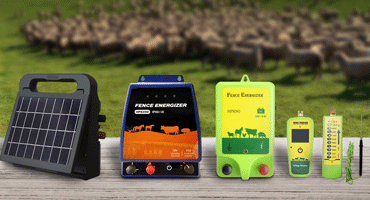
Four models that represent the range a distributor is most likely to order, from a 3.5 J workhorse to the tester that resolves most field complaints.

3.5 J AC/DC workhorse
3.5 J output · 250 acres · 55 miles · 2-year warranty
The volume SKU for horses and cattle on long runs.
View product details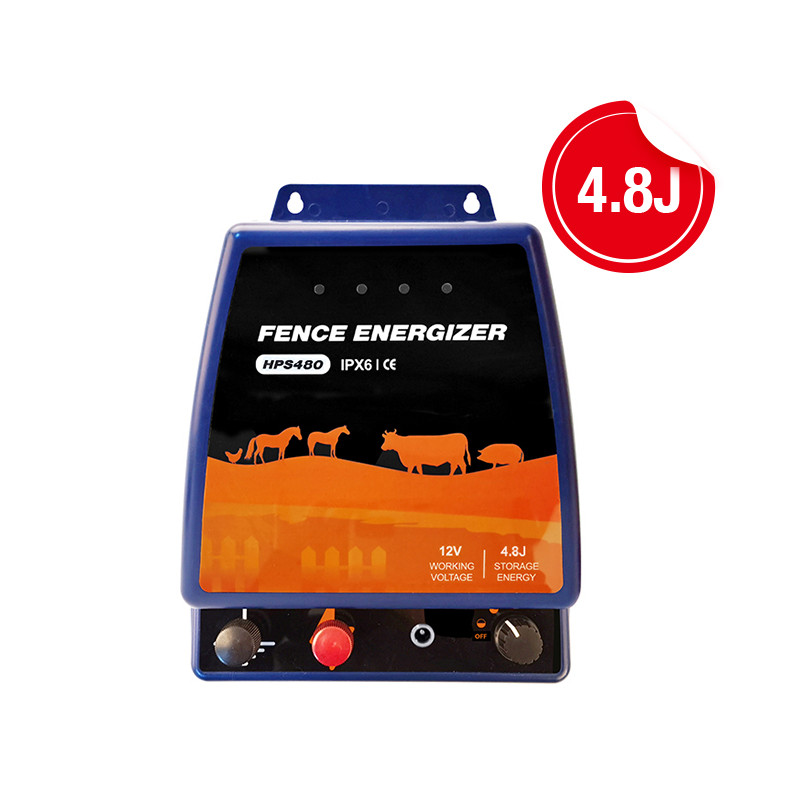
4.8 J with power reserve
4.8 J output · 110 V AC · 2-year warranty
Holds voltage when vegetation load rises after rain.
View product details
6 J input / 3.6 J output
3.6 J delivered · solar 15 V · 60-mile range · 2-year warranty
The clearest example of stored versus delivered energy in the range.
View product details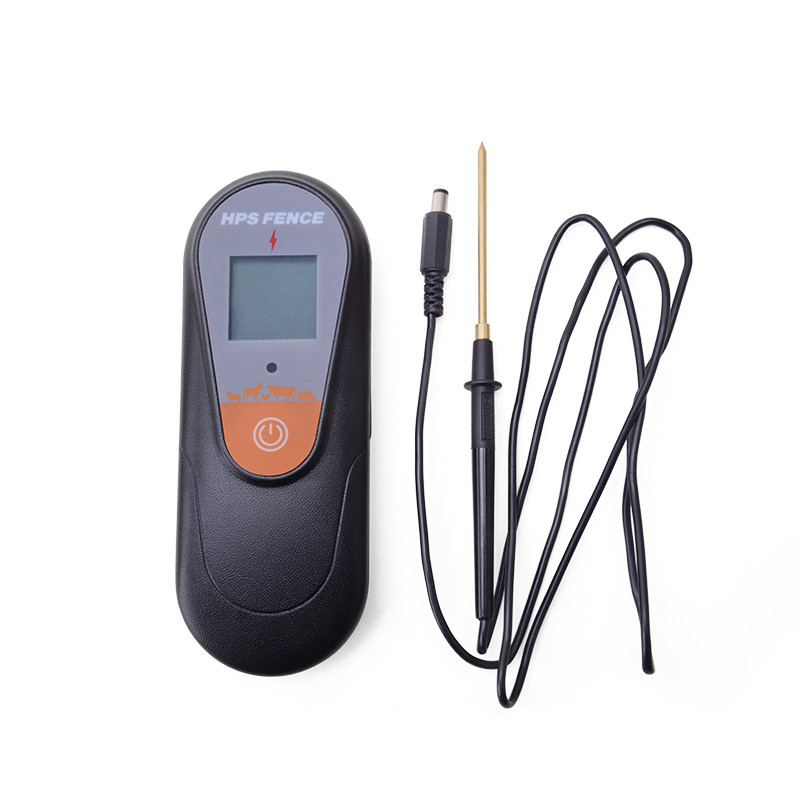
Digital fault-finding tester
0–13 kV · LCD · 9 V battery · 1-year warranty
The tool that turns a field complaint into a measurable reading.
View product detailsElectric fence energizer testing FAQ
How is electric fence energizer joule output actually measured?
The energizer is connected to a resistive load, the pulse is captured on an oscilloscope, and energy is integrated over the pulse duration. That gives the delivered figure at the terminals; the label figure is stored energy in the capacitor, which is why HPS FENCE 12 J models measure about 7.2 J.
What does a 72-hour ageing test on an electric fence energizer prove?
It forces early component failures to happen in the factory instead of in the field. Output voltage, joule energy and temperature are monitored through 72 hours of continuous running, and a unit that drifts outside tolerance is rejected before packing.
Can a distributor receive the test report for their energizer order?
Yes. Test records are linked to model and batch, so specifying the models and quantities in the order is enough to pull the matching records. Ask for the batch number on the report, not only the model, or the document proves nothing about your shipment.
Is IPX6 tested on production units or only on prototypes?
Verification is tied to production batches rather than a single prototype, which is the distinction that matters when an importer has to defend the marking. A prototype certificate says the design can pass; a batch record says the units you received did pass.
What is the MOQ if a dealer wants to test a batch before committing?
One unit for energizers, testers and coop doors, and 100 for other categories. Mixed-model orders are accepted, so a dealer can take one unit of each joule rating, run a field test, and place the volume order against measured results.

HPS FENCE · MANUFACTURER & WHOLESALE SUPPLIER
Your Trusted Partner for Electric Fencing & Farm Solutions
From electric fence energizers and fencing accessories to poultry farming equipment, HPS FENCE supports global distributors, wholesalers, importers, and brands with reliable products, flexible OEM/ODM customization, and long-term supply solutions.
Sources
- IEC 60335-2-76 / EN IEC 60335-2-76 — output energy, pulse duration and repetition rate measured into a 500 Ω load.
- HPS FENCE output test records — oscilloscope waveform and efficiency measurements, published on the real-output test page.
- HPS FENCE production process documentation — 72-hour ageing, electrical performance testing and three-proof PCB coating.
- HPS FENCE box drop test documentation — drop heights, orientations and post-impact function checks.
- HPS FENCE certification page — CE / RoHS / TÜV / SGS records and IPX6 verification.