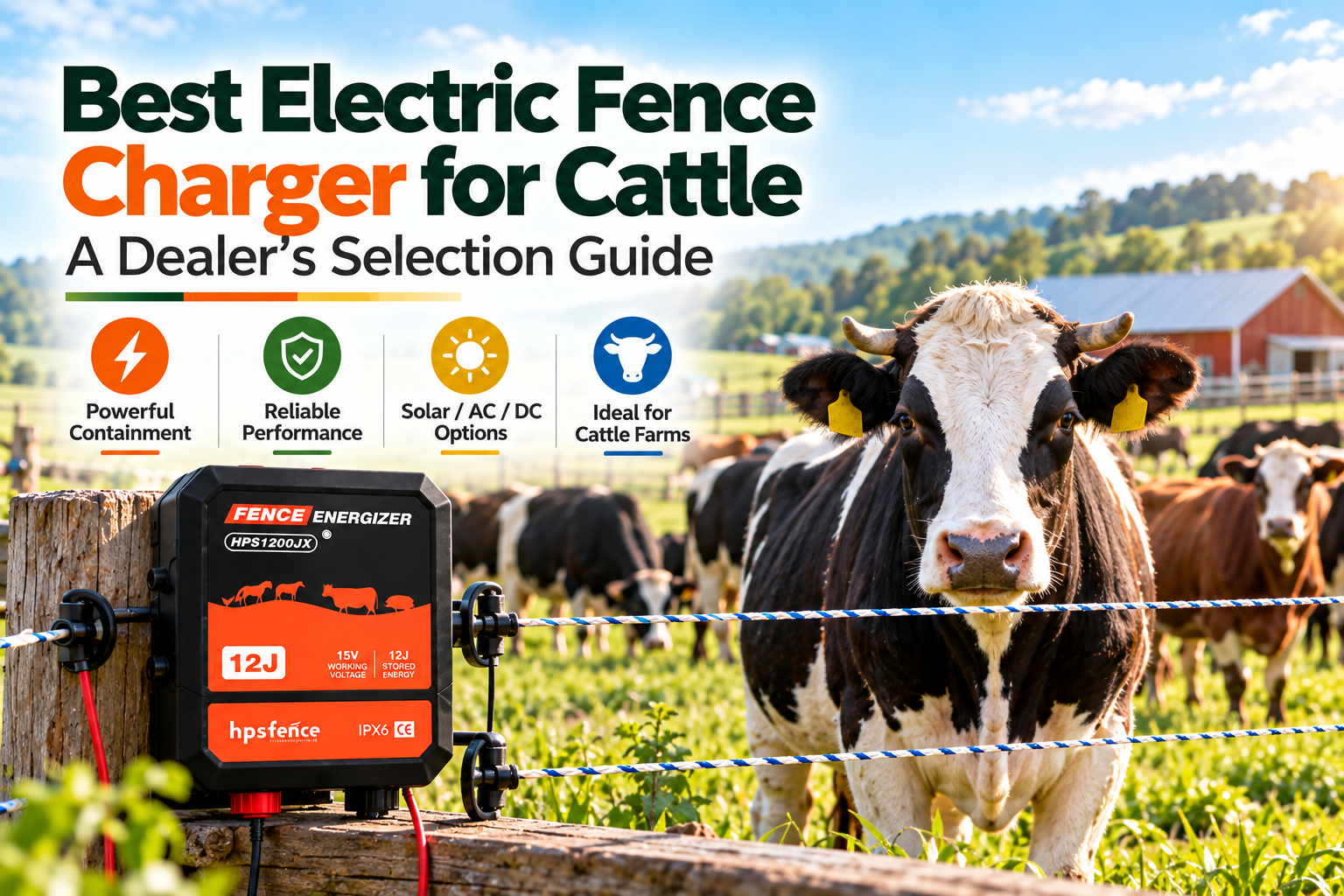
Best Electric Fence Charger for Cattle: A Dealer's Selection Guide
Oct 23,2026
Cattle do not test a fence gently. A heifer that walks through once will walk through again, and the customer will blame the charger. That is why the best electric fence charger for cattle is judged on two numbers — delivered joules and voltage at the far end — not on the peak voltage printed on the box. This guide gives dealers a repeatable way to size a cattle charger by herd size, fence layout and power source.
Direct answer
For cattle, the workable target is 2,000 V or more at the far end of the fence, backed by 2–4 J of delivered energy. A 3.5 J AC/DC charger covers most herds up to 55 miles of clean fence; step to 4.8 J where the fence runs through grass or along a wet boundary. Under-sizing by one band is the single most common cause of a cattle charger being returned.
Quick facts
Cattle and goats need 2,000 V minimum at the fence; wooled sheep need 3,000 V and horses 1,500 V (KZN Agriculture & Rural Development).
Earth rods scale with output: a 1 J charger needs one 20 mm × 1 m rod, a 20 J unit at least 20 (KZN Agriculture).
IEC 60335-2-76 limits every pulse to 5 J, 10 ms and 1 Hz — a compliant charger cannot “overpower” cattle, only under-deliver.
MOQ is one unit on energizers and testers, with mixed-model trial orders accepted for a first cattle-season shipment.
Why the best electric fence charger for cattle is a system, not a box
A charger delivers a pulse; the fence, the insulators and the earth decide how much of that pulse reaches the animal. Two farms can buy the same 4.8 J unit and get 6,000 V on one and 2,800 V on the other, purely because one has three earth rods in dry clay and the other has one rod in damp loam.
When a dealer quotes a cattle farm, the charger is the easy part. The specification that prevents complaints is the earth and the conductor, and both should be written on the quotation next to the model number.
Cattle voltage and joules: what the animal actually needs
Voltage is pressure; joules are the delivered work. Cattle have a thin hide and learn quickly, so 2,000 V is enough pressure — but the pulse still has to carry enough energy to be unmistakable through a winter coat and muddy conditions. In practice 2–4 J delivered covers a commercial herd; below 2 J the first contact is often unconvincing and the animal tests again.
Requirement
Target for cattle
What happens if it is missed
Voltage at the far end
2,000 V or more
Animal tests the fence, then walks through
Delivered energy
2–4 J
Weak first shock; repeated breaches in the first week
Pulse duration
≤10 ms (IEC 60335-2-76)
Non-compliant and unnecessary for animal control
Earth
1 rod per joule of output, minimum
Voltage collapses under load; charger gets blamed
Targets follow KZN Agriculture & Rural Development guidance and IEC 60335-2-76 limits.
Four charger types sold to cattle farms
Type
Strength
Weakness
Sell it when
Mains AC
Lowest cost per joule, no battery to replace
Needs a power point at the fence
Yards, dairy and laneways with mains nearby
12 V battery
Works anywhere, easy to move
Battery maintenance becomes a service issue
Temporary grazing and leased blocks
Solar
No mains, no manual battery swaps
Winter capacity is set by panel and battery
Remote paddocks, 30–60 mile runs
AC/DC combination
One SKU covers both customers
Slightly higher unit cost
Dealers who want fewer SKUs and fewer wrong shipments
For a dealer, the combination unit is usually the better stock decision: one SKU serves the customer with a power point and the customer who grazes a block 4 km away, and the wrong-unit problem disappears.
Five chargers for five cattle farm sizes
Farm profile
Recommended output
Why this band
Under 20 head, holding paddock
0.5–1 J
Short runs; voltage, not energy, is the limit
20–50 head, permanent boundary
2 J, 9 kV peak
Enough reserve for gate sections and wet corners
50–150 head, multi-paddock
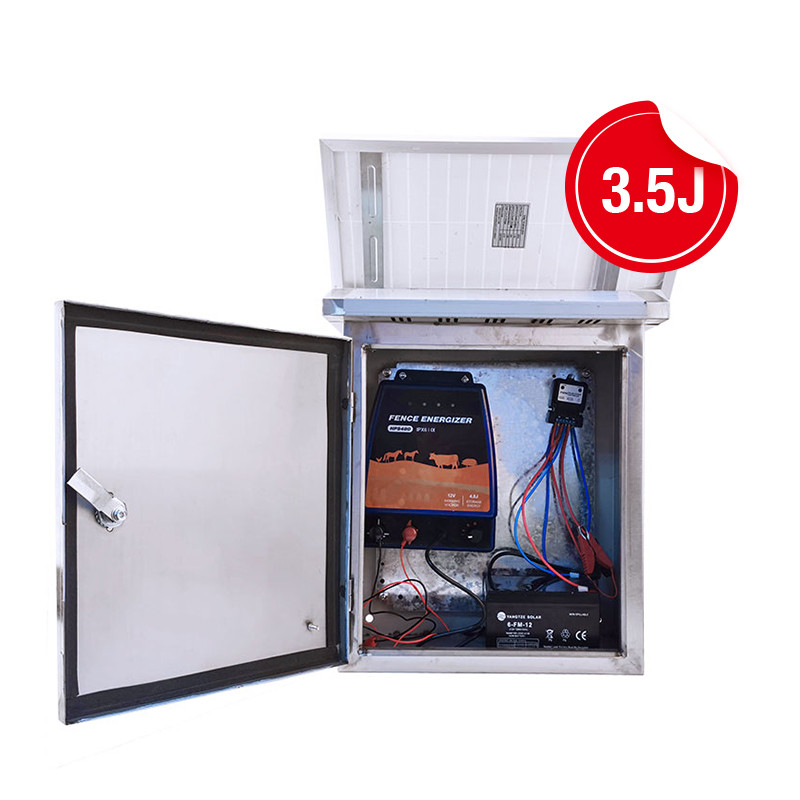
3.5 J
Covers 55 miles of clean fence with margin for vegetation
150+ head or heavy grass
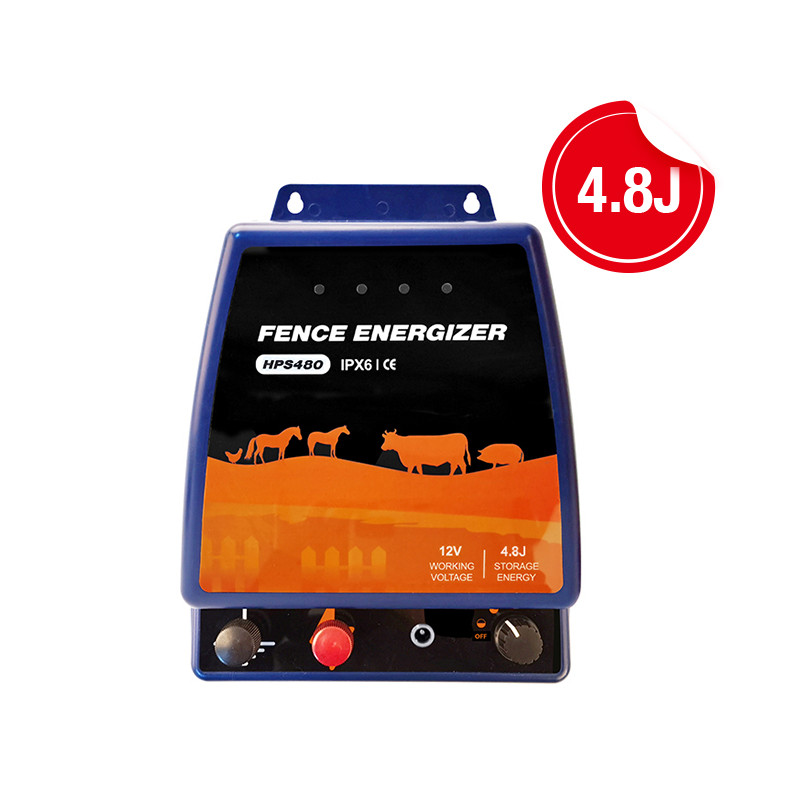
4.8 J
Retains voltage where grass contact loads the line
Reserve or wildlife boundary
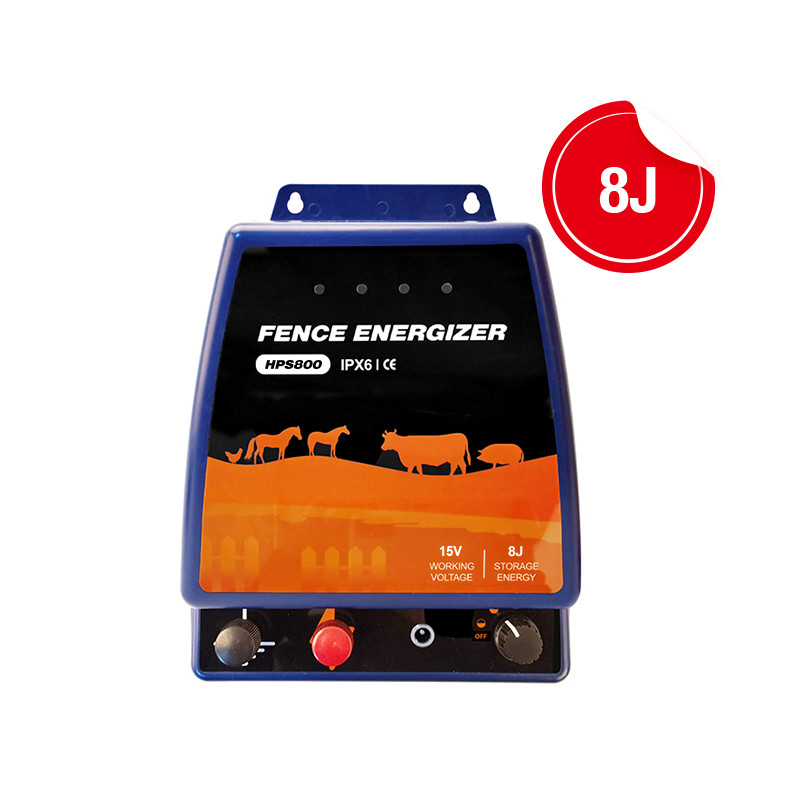
8–12 J
Energy for thick-skinned animals across long runs
These bands assume a permanent fence with steel or high-tensile wire and a correct earth. For temporary polywire runs, choose one band lower — the conductor itself limits what the animals receive, and a larger charger will not compensate for a thin wire with poor contact.
Cattle learn within a few contacts. The job of the charger is to make the first contact unmistakable, then hold voltage through the season.
Electric fence grounding: the half of the circuit that fails
The pulse leaves the charger, travels the fence, passes through the animal and returns through the soil to the earth rods. Dry soil, a single short rod or a corroded clamp adds resistance on the return path, and the animal feels less — even though the charger is working perfectly.
Earth rods required against charger output (KZN guidance)
1 J charger
1 rod
3.5 J charger
4 rods
4.8 J charger
5 rods
8 J charger
8 rods
12 J charger
12 rods
20 J charger
20 rods
20 mm × 1 m galvanised rods, spaced along the fence line, not bunched at the charger. This is the specification that should travel with the unit.
This is also the answer to the most common cattle-farm support call: “I upgraded to a bigger charger and the fence got worse.” The bigger unit needs more earth, and if the rod count stayed the same, the extra output is dissipated in the soil.
What dealers get wrong when quoting cattle farms
Quoting stored joules. A 6 J input unit delivering 3.6 J will lose to a 4.8 J unit delivering 4.8 J, and the customer will discover it in the field.
Leaving the earth out of the quote. The rod count is part of the system, and it costs less than a return visit.
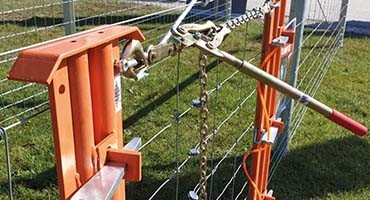
Ignoring the gate sections. Undersized gate handles and buried cable are where cattle fences fail first, not at the charger.
Forgetting the tester. A £20 tester converts most voltage complaints into a five-minute conversation about earthing.
HPS FENCE as an electric fence energizer manufacturer
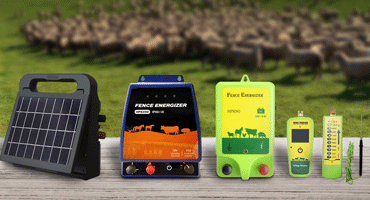
HPS FENCE is the brand of Hangzhou Opus Fence Supplies Co., Ltd, building energizers in Hangzhou since 2013 with category experience back to 2002. The range runs from 0.25 J to 12 J across mains, battery, solar and AC/DC formats, sealed to IPX6, and is exported to distributors in Australia, New Zealand, Europe, the United States, Canada, South America, Korea and Japan.
2013Founded in Hangzhou
0.25–12 JEnergizer output range
IPX6Ingress protection
2 yearsStandard warranty
Measured joule output
Real output test method published, not just a label value.
Private label covers the housing label, retail box, manual, model naming, colour and output specification. Label-only changes start at one unit on stock models; new housings and new joule ratings are quoted as an ODM project with MOQ confirmed per project.
Branding and packaging
Logo on housing, retail box and manual
Model naming and colour to suit your catalogue
Packaging engineered for e-commerce and container transit
Technical and documentation
Output voltage and joule specification per market
Multilingual manuals
Full ODM development with scheduling and sample approval
Wholesale terms for cattle charger buyers
MOQ1 unit for energizers, testers and coop doors; 100 for other categories
Trial ordersSmall-batch and mixed-model orders accepted
3.5 J delivered covers 100 head on a permanent multi-paddock fence of up to about 55 miles of clean line. Move to 4.8 J if the fence crosses heavy vegetation, runs along a wet boundary or the soil is dry and rocky.
Is 2,000 V enough for cattle?
Yes. 2,000 V at the far end is the government minimum for cattle and goats, and it is enough because cattle have a thin hide and learn quickly. The number to watch is the reading at the far end, not at the charger terminals.
Should a cattle farm use AC or solar?
Mains AC where a power point exists at the fence, solar where it does not. In cold climates, size the solar unit one band higher because sealed lead-acid capacity falls below freezing.
What is the MOQ for wholesale cattle fence chargers?
One unit on energizers, testers and coop doors; 100 units on other categories. Mixed-model orders are accepted, so a dealer can take two or three joule ratings for a first cattle season.
Can you supply the earth rods and gate hardware with the charger?
Yes. Earth rods, clamps, gate handles and underground cable are orderable line items, so a dealer can quote the whole circuit rather than the box alone.
Sources
KZN Department of Agriculture & Rural Development — Electric Fencing in Agriculture: minimum voltage by species, earth peg requirements and conductor spacing.
IEC 60335-2-76:2002+A1:2006 / BS EN IEC 60335-2-76:2021 — output energy ≤5 J, pulse duration ≤10 ms, repetition rate ≤1 Hz.
IEC 60479-1 — effects of current on human beings and livestock.
HPS FENCE product specifications — delivered output energy, peak voltage, coverage and power source for HPSA200-AC/DC, HPS350, HPS480, HPS800, HPSS350 and HPSS600.
HPS FENCE — How to Test Real Output: measured efficiency of 12 J models at about 58–60%.
Your Trusted Partner for Electric Fencing & Farm Solutions
From electric fence energizers and fencing accessories to poultry farming equipment, HPS FENCE supports global distributors, wholesalers, importers, and brands with reliable products, flexible OEM/ODM customization, and long-term supply solutions.