
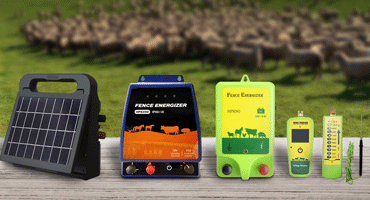





Best Electric Fence Charger: How to Choose in 2026 (Buyer's Guide)
Search for the best electric fence charger and you will find dozens of ranked lists that disagree with each other. The reason is simple: a charger is only “best” against a fence length, an animal and a power source. This guide replaces the ranking with four decisions, then shows which specification wins in each case — written for dealers, importers and brand owners who have to defend the choice to a customer.
Choose in this order: animal (voltage target), fence length (delivered joules), power source (mains, 12 V, solar or AC/DC), then documentation (CE, RoHS, TÜV, SGS and EN IEC 60335-2-76 reports). For most mixed farms, a 3.5 J AC/DC charger is the correct answer; solar replaces it only where there is no mains supply, and 4.8 J replaces it only where vegetation or distance loads the line.
Quick facts
- Voltage targets: 1,500 V horses and pigs, 2,000 V cattle and goats, 3,000 V wooled sheep, measured at the far end (KZN Agriculture & Rural Development).
- Every compliant charger is capped by IEC 60335-2-76 at 5 J per pulse, 10 ms duration and 1 Hz repetition.
- HPS FENCE publishes delivered output: a 12 J model measures about 7.2 J, roughly 60% of the stored rating.
- MOQ is one unit on energizers and testers; CE, RoHS, TÜV and SGS documents ship with the order.
Best electric fence charger: four questions that decide it
| Question | What it changes | Typical answer |
|---|---|---|
| Which animal? | Voltage target and energy band | Cattle 2,000 V / 2–4 J; horses 1,500 V; wooled sheep 3,000 V |
| How far, and through what? | Delivered joules and charger class | Under 20 km clean: 2 J. 20–90 km: 3.5–4.8 J. Heavy grass: one band up |
| What power is available? | Mains, 12 V, solar or AC/DC | Mains at the fence: AC. No mains: solar. Mixed customers: AC/DC |
| What has to be documented? | Model choice and market fit | EN IEC 60335-2-76 report, DoC, RoHS, EMC, labels, manual language |
Answer them in this order. Answering “how many joules” before “which animal” is why so many chargers are returned as underpowered.
Stored versus delivered joules: the 40% gap in electric fence chargers
The joule figure on the box is stored energy in the capacitor. What reaches the fence is lower, because the transformer and switching circuit lose energy on every pulse. Buyers compare labels; animals respond to delivered energy, and the gap between the two decides whether a specification is honest.
Measured into a resistive load at the terminals. A 40% gap between label and output is normal; a 87% gap is a specification problem, not a rounding difference.
Ask every supplier for the delivered figure and the load it was measured into. A supplier who answers “12 J” without a load condition is quoting a label, not a test.
Electric fence charger power source: mains, 12 V, solar or AC/DC
| Source | Best for | Watch out for |
|---|---|---|
| Mains AC 110–240 V | Yards, dairy, laneways, any fence with a power point | Voltage spikes and lightning; fit a diverter |
| 12 V battery | Temporary grazing, leased blocks, rapid redeployment | Battery maintenance becomes the dealer's support burden |
| Solar 12 V | Remote paddocks and long boundaries with no supply | Winter capacity: size one band above the summer calculation |
| AC/DC combination | Dealers who want one SKU for both customer types | Slightly higher unit cost than a single-source unit |
Fence length and vegetation: the real coverage limit
Published coverage assumes clean wire, dry conditions and a correct earth. Grass contact, rusty joints and undersized conductors reduce it, and the reduction is not linear: a fence that holds 6,000 V in dry August can read 3,500 V after a week of rain and fast grass growth.
Manufacturer's published maximum for clean fence. For heavy vegetation, treat these as half.
Electric fence charger voltage by species: the table that settles arguments
| Animal | Minimum at the far end | Why |
|---|---|---|
| Horses | 1,500 V | Thin skin, sensitive; visibility matters more than energy |
| Pigs | 1,500 V | Thin skin, but strong urge to root under the wire |
| Cattle | 2,000 V | Thin hide, learns within one or two contacts |
| Goats | 2,000 V | Test fences with horns and shoulders; browse over the top |
| Sheep, wooled | 3,000 V | Wool insulates the animal from the conductor |
| Poultry | 2,000 V on netting | Short runs; the netting limits current more than the charger does |
Figures follow KZN Agriculture & Rural Development guidance and are measured at the far end of the fence, not at the charger.
Best electric fence charger in 2026: shortlist by use case
| Use case | Recommended | Why this one |
|---|---|---|
| Smallholding with mains | HPSA200-AC/DC, 2 J / 9 kV | Covers cattle and horses with reserve for gate sections |
| Mixed farm, mains or battery | HPS350, 3.5 J | 55 miles of clean fence; one SKU for two customer types |
| Long run through grass | HPS480, 4.8 J | Holds voltage where vegetation loads the line |
| Remote paddock | HPSS350 or HPSS600 | 30 or 60 mile range with no mains supply |
| Reserve or wildlife | HPS800, 8 J / 13 kV | Energy for thick-skinned animals over 80 km |
| Poultry and garden | HPSA025, 0.25 J | Correct band for netting; anything larger is wasted |
Electric fence charger certification: the documents importers should check
For a European buyer, the specification is only half the decision. The other half is the document pack: a CE Declaration of Conformity signed by the manufacturing entity, test reports to EN IEC 60335-2-76 for the exact model, EMC and RoHS evidence, battery documentation where a battery is supplied, and labels and manuals in the destination language.
- DoC signatory. If the name on the declaration is not the manufacturer, the document proves very little.
- Model match. Reports must reference the model and variant being shipped, not a “typical” unit.
- FCC is not EU evidence. It covers the United States only; a supplier who offers it for Europe is telling you something about the rest of the pack.
- GPSR responsible person. Under Regulation (EU) 2023/988 the economic operator must be named on the product or packaging.
HPS FENCE as an electric fence charger manufacturer
HPS FENCE is the brand of Hangzhou Opus Fence Supplies Co., Ltd, building chargers in Hangzhou since 2013 with category experience back to 2002. Output spans 0.25 J to 12 J across mains, battery, solar and AC/DC, sealed to IPX6, and exported to Australia, New Zealand, Europe, the United States, Canada, South America, Korea and Japan in that order of priority.
Real output test method published, not just a label value.
Read the test methodContinuous run with output, energy and temperature monitored.
See the production processPackaging verified for container and parcel transit.
See the drop testVerified per production batch, not on a single prototype.
View certificationsEvery unit checked before packing, with batch traceability.
Inspection stepsOutput and safety data filed by model and batch, supplied with the order.
Request a batch recordOEM and private label for charger ranges
Private label covers the housing label, retail box, manual, model naming, colour and output specification. Label-only changes start at one unit on stock models; a new housing or a new joule rating is an ODM project with tooling and MOQ confirmed per project.
Branding and packaging
- Logo on housing, retail box and manual
- Model naming and colour to suit your catalogue
- Packaging engineered for e-commerce and container transit
Technical and documentation
- Output voltage and joule specification per market
- Multilingual manuals
- Full ODM development with scheduling and sample approval
Wholesale terms for charger buyers
Chargers that cover most enquiries

Mains entry unit
0.25 J stored · 0.13 J delivered · 110–240 V AC
Poultry netting and garden runs where 0.5 J would be wasted.
View product details
0.5 J dual source
0.5 J delivered · AC 110–240 V or 12 V DC
Smallholdings and starter dealer ranges that need one SKU for both.
View product details
3.5 J workhorse
3.5 J · 55 miles clean fence · 250 acres
Mixed farms, horses and cattle, mains or battery.
View product details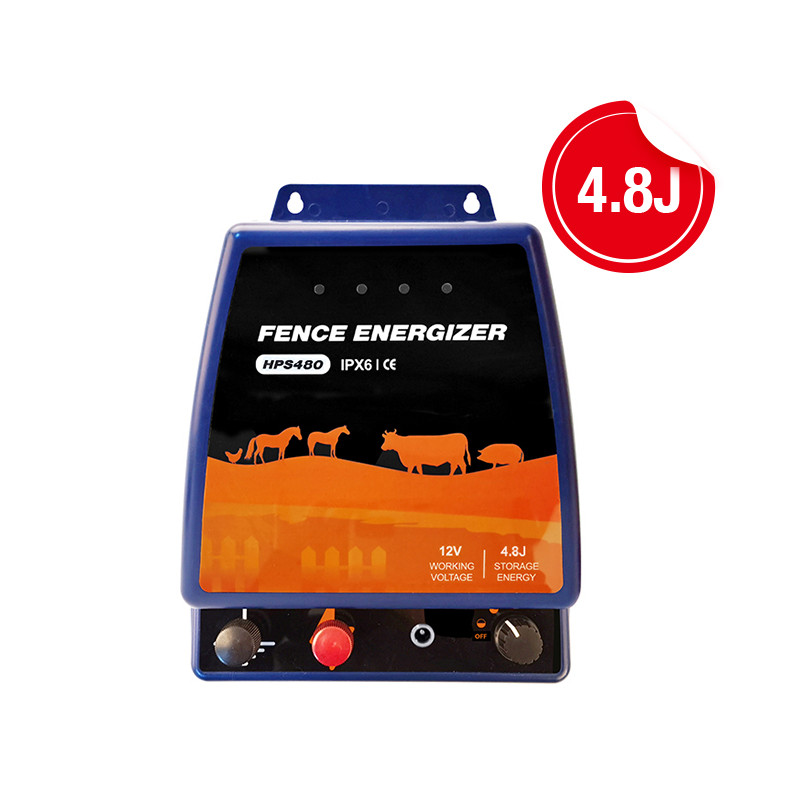
4.8 J heavy duty
4.8 J · AC 110 V · added power reserve
Long runs through grass and along wet boundaries.
View product details
Solar 6 J
6 J input · 3.6 J delivered · 60-mile range
Remote runs where a 30-mile solar unit would be at its limit.
View product details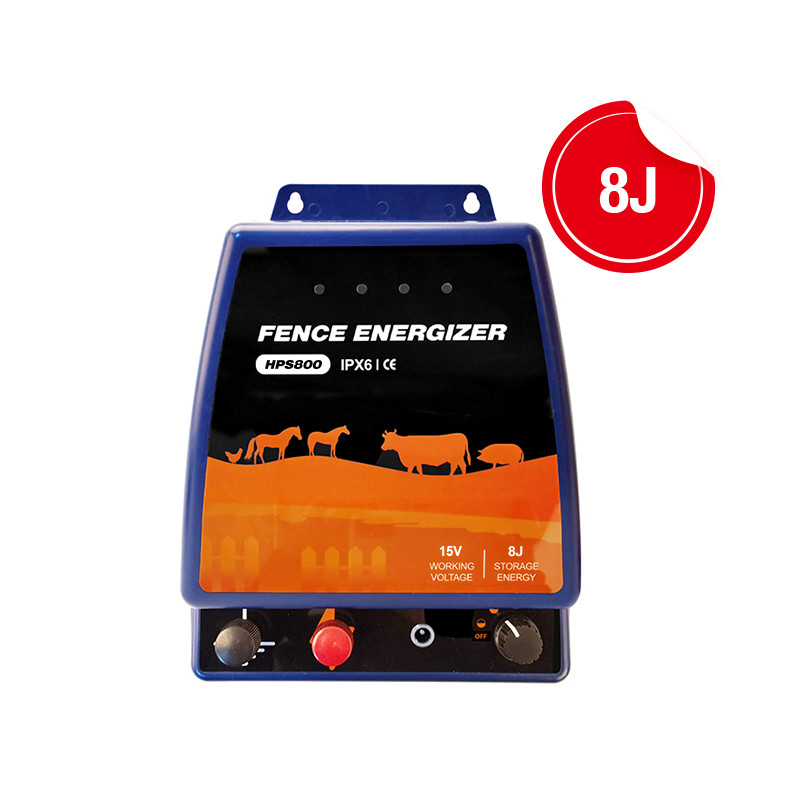
8 J high power
8 J input · 4.8 J delivered · 13 kV · 80 km
Reserve boundaries and thick-skinned wildlife.
View product detailsBest electric fence charger FAQ
What is the best electric fence charger overall?
For most mixed farms, a 3.5 J AC/DC charger is the best compromise: it covers horses and cattle, runs from mains or a 12 V battery, and holds about 55 miles of clean fence. The answer changes only when there is no mains supply or the fence runs through heavy vegetation.
Is a higher joule rating always better?
No. Above 4.8 J the returns flatten for livestock, while cost, battery drain and earth requirements rise. Extra energy pays off only on very long runs, heavy vegetation or wildlife.
Which certifications should a charger carry for import?
CE with an EU Declaration of Conformity, RoHS evidence, EMC documentation and test reports to EN IEC 60335-2-76 for the exact model. FCC covers the United States only and is not EU evidence.
What is the MOQ for wholesale electric fence chargers?
One unit on energizers, testers and coop doors; 100 units on other categories. Mixed-model orders are accepted, so a distributor can build a range across three joule bands in one shipment.
Can output voltage and joules be customised per market?
Yes. OEM and private-label programmes cover output specification, housing colour, model naming and manual language. MOQ for a custom specification is confirmed per project, because tooling and test requirements change with the change.
Sources
- KZN Department of Agriculture & Rural Development — Electric Fencing in Agriculture: voltage minima by species, earth requirements, conductor spacing.
- IEC 60335-2-76:2002+A1:2006 / BS EN IEC 60335-2-76:2021 — output energy ≤5 J, pulse duration ≤10 ms, repetition rate ≤1 Hz.
- Regulation (EU) 2023/988 (GPSR) — economic operator identification and traceability requirements, applicable from 13 December 2024.
- IEC 60479-1 — effects of current on human beings and livestock.
- HPS FENCE product specifications — delivered output energy, peak voltage, published coverage and power source across the 0.25–12 J range.
Related electric fence buying guides
- Best Electric Fence Energizer: 7 Models Ranked by Farm Size and Species — the ranked shortlist across species and power types
- Best Electric Fence Charger for Cattle: A Dealer's Selection Guide — cattle voltage targets, joules and the earth-rod rule
- Best Electric Fence Tester: 4 Models Compared for Dealers — how to diagnose a weak fence before replacing a charger
HPS FENCE · MANUFACTURER & WHOLESALE SUPPLIER
Your Trusted Partner for Electric Fencing & Farm Solutions
From electric fence energizers and fencing accessories to poultry farming equipment, HPS FENCE supports global distributors, wholesalers, importers, and brands with reliable products, flexible OEM/ODM customization, and long-term supply solutions.